


She called me on a Sunday to tell me she was saying no.
The role was the one everyone in her inner circle assumed she’d take. Right title. Right logo. A package most of her peers would have DocuSigned at a red light.
A smaller remit than she wanted—though nobody would have known it from the logo. That’s what logos are for.
We debated the move for a week and a half. Then she pulled the trigger.
The conversation was less uncomfortable than you’d think. Here it is, in full:
“You’re probably not going to like this conversation. I want to thank you for running a thoughtful hiring process—I don’t say that often.
I’m going to pass on the role. The remit is ultimately smaller than what I want to own next, and I’d rather tell you that plainly than dance around it.
If the scope changes—or the next search does—I want to be a call you make. In the meantime, I know two people who’d be strong in this seat. Happy to make the introduction.”
That’s it. No apology tour. No door slammed.
A few weeks later, her phone changed. Four inbound approaches—one from a company that had passed on her less than a year earlier. Bigger scope. Meaningfully bigger numbers.
Nothing about her had changed. No new credential. No press. No viral post.
The only thing that changed was what the market knew she had refused—and none of it was luck.
We built the decline with purpose.
The No Travels Farther Than the Yes
In a recent piece mapping how deals change as the numbers climb, I left a sentence hanging on purpose:
Turning down the wrong recruiter, communicated correctly, creates more leverage than accepting ten of them.
A few of you noticed. These are the mechanics.
When an opportunity lands in your lap—even one you don’t want—declining it feels like waste. An offer in hand feels like money already in your pocket. Saying no feels like setting it on fire.
That feeling is real. It’s also lying to you.
Because a decline is not an exit. It’s a signal.
The market doesn’t just price what you accept. It prices what you refuse. Every serious operator you’ve ever admired is partly priced off a ledger of things they turned down—and the market keeps that ledger whether you manage it or not.
Say no to the wrong thing. Let the right people know you said it. You don’t lose the option.
You become the option.
You don’t have to take my word for it.
Watch the market I’ve been living in for the past several months. In the race for frontier AI talent, nine-figure packages have been dangled—and, publicly, declined. And notice what happened to the people who declined them: their price went up.
Every publicized no repriced the refuser upward, because the market read the refusal exactly the way it reads scarcity everywhere else.
The contractor who can’t get to your roof until October is the one you trust with your roof. The one who can start tomorrow makes you nervous. Same house. Same shingles.
Executive talent works the same way. We just pretend it doesn’t.
One correction before you sharpen the axe, though—because I watch executives get this backwards.
The instinct, once you believe in the power of the no, is to start declining fast.
Screening call? No. Recruiter ping for a lateral role? No. It feels decisive. Ruthless with your time.
That instinct is throwing away the asset before you’ve minted it.
The no is valuable. The no at the right time is what moves markets. And the right time is almost never the first conversation—because every process you stay in, even one you’ll never accept, is paying you before any offer exists:
Comp intelligence you can’t buy. Real ranges, real structures, real equity math—from the only source that isn’t a survey: the people trying to hire you.
A benchmark on yourself. How rooms respond to you now, at this level, is data. You can’t price yourself off a three-year-old memory.
Reps. Evaluation conversations are a skill, and the executives who are calm in the room that matters got calm in ten rooms that didn’t.
The mindset shift. Enough conversations and you stop showing up as a candidate and start showing up as a consultant—someone diagnosing their problem, not auditioning for their approval. That shift alone changes what they offer you.
A wider circle. Every process you exit well is a place to send a friend. The referral costs you nothing, deepens two relationships, and quietly makes you the person who knows people.
Then—when you’ve taken what the process has to give, and the remit is truly wrong—you decline.
From knowledge, not reflex.
A no you haven’t earned intel from is just a missed meeting. A no you’ve earned is a position.
The Sentence
So how does a decline become leverage instead of a closed door?
It comes down to one sentence—a sentence I’ve heard move more money than most counteroffers. It sounds like this, delivered in an ordinary career conversation:
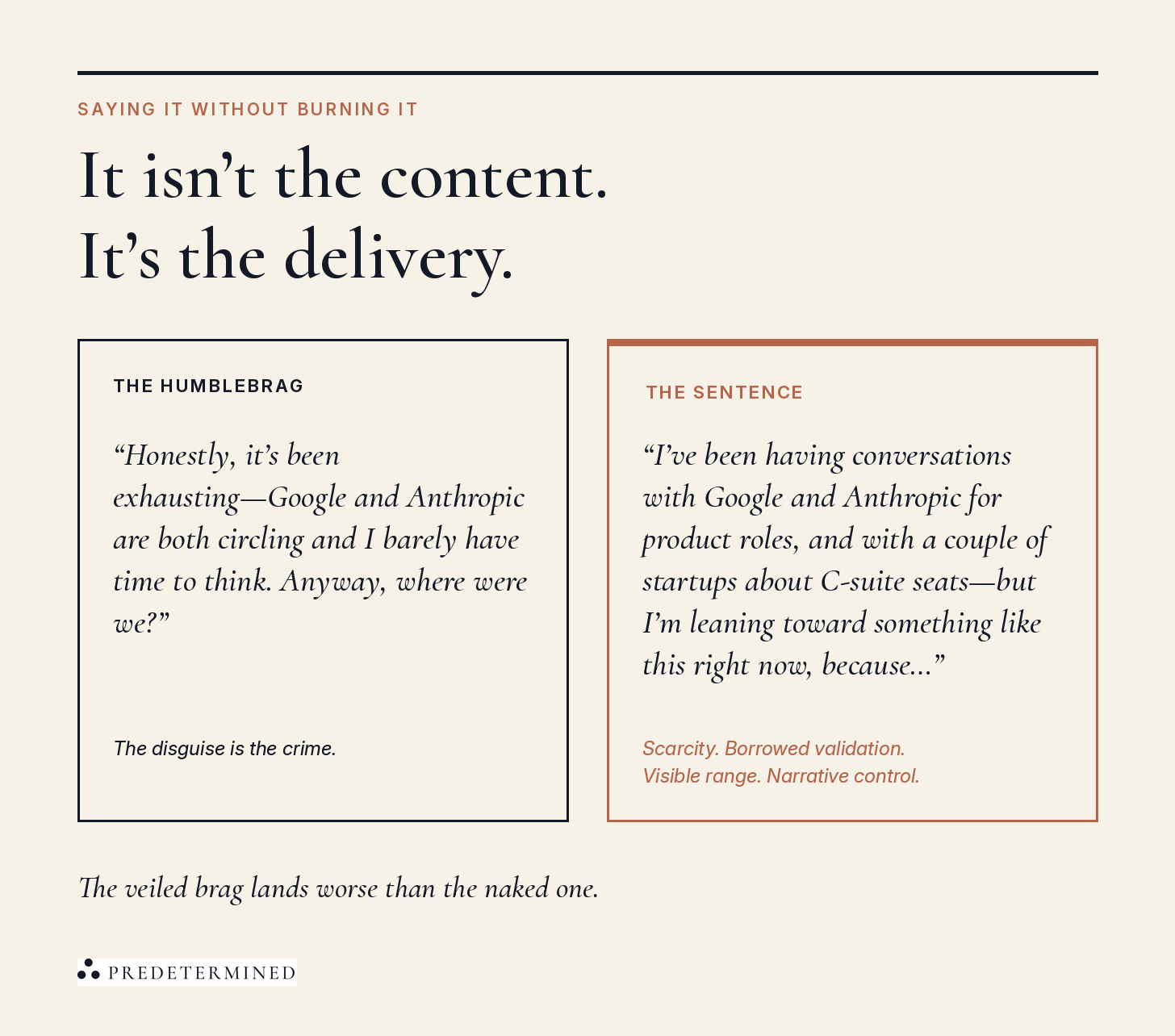
“I’ve been having conversations with Google and Anthropic for product roles, and with a couple of startups about C-suite seats—but I’m leaning toward something like this right now, because…”
One sentence. Ordinary tone. No numbers, no demands, no deadline.
It isn’t the ask. It’s the ground the ask will stand on.
And four separate influence mechanisms fire at once.
Let’s take it apart.
“I’ve been having conversations.”
Not offers. Conversations. This is the load-bearing word choice of the entire sentence. An offer invites verification—someone can ask to see it, call around, test it. A conversation is credible and unverifiable at the same time. It says the market is active around you without handing anyone a claim to check. The moment you say “competing offers,” you’ve started a game of show-me. “Conversations” never starts that game.
“with Google and Anthropic.”
You never said you were good. They did—by pursuing you. This is the oldest trick that isn’t a trick: the prestige of the people who want you transfers to you, and it lands harder than any self-description ever could, because a claim about yourself gets audited and a claim about who’s chasing you gets absorbed. The listener does the math on their own, which means they believe it.
“for product roles, and with a couple of startups about C-suite seats.”
Range. Big platforms want you for craft; smaller ones want you for command. Two different markets are bidding on two different versions of you. You didn’t say that. The sentence did.
“but I’m leaning toward something like this right now, because…”
The most important clause—and the one everyone botches. This is where you take the wheel of the story. You’re the one narrating why you’re walking toward one thing and away from others, and whoever narrates the why owns the perception.
Skip the because and you’re a mercenary weighing bags of money. Land it—on mission, on the problem, on the people—and you’re a person making a considered choice that this room happens to be winning.
Four triggers. Scarcity. Borrowed validation. Visible range. Narrative control.
One breath.
They Can’t See Your Board
Why does this work on sophisticated people—recruiters and operators who run this exact game for a living?
Because of something I call Narrative Asymmetry: the company controls the story of the role, but you control the story of your market.
They cannot see your board.
You know which of your conversations are live, which are warm, which died two months ago. They know none of it—and in executive hiring, with its NDAs and quiet processes, they have no polite way to find out.
You control the frame. They price off the frame.
The discipline is in the calibration: reveal enough to be credible, never enough to be verified. That gap—between what they can sense and what they can check—is the leverage. Not the names. Not the numbers.
The gap.
Saying It Without Burning It
Now the tension, because this is where the whole thing lives or dies.
The same sentence that builds gravity can detonate. The line between the two isn’t the content.
It’s the delivery.
Here’s what most people actually say when they try to signal options:
Script A: “Honestly, it’s been exhausting—Google and Anthropic are both circling and I barely have time to think. Anyway, where were we?”
Feel the difference? That’s not a signal. That’s a humblebrag—and the humblebrag is one of the most reliably self-destructive sentences in professional life.
Sezer, Gino, and Norton at Harvard ran nine studies on exactly this and found something that should be a sticky note on every exec’s laptop: the veiled brag lands worse than the naked one.
People rated humblebraggers as less likable and less competent than people who just plainly bragged—and the complaint-wrapped version rated below people who simply complained. The listener smells the disguise, and the disguise is what they hold against you. Insincerity costs more than arrogance.
Brutal.
So the delivery rules are simple, and they’re strict:
Say the sentence once. Return to the board often.
The claim appears one time—said, then left alone. Repeating it converts a fact into a campaign, and campaigns get audited.
But the substance of your board is a different asset, and it’s reusable.
Later in the conversation, when they raise a challenge, the strongest move on the table:
“Funny you mention that—the team at Google was wrestling with a version of the same problem. Here’s what I noticed…”
You’re no longer the candidate with options. You’re the person in enough rooms to see the pattern—and you’re handing them intel they can’t get anywhere else.
Every callback like this re-proves the sentence without restating it. This is the consultant mindset from earlier, cashed in.
One discipline: share the pattern, never the confidence. Nothing a company would recognize as theirs. The moment you leak, the room learns what you’d do with their secrets.
Say it as an answer, not an announcement.
It belongs in the natural slot where someone asks what you’re weighing, where your head is, what’s next.
Volunteered cold, it’s a flex. Offered in answer, it’s disclosure.
Flat tone.
You’re reporting weather, not revealing a hand. The moment your voice leans on the names, the names stop working for you and start working against you.
Spend the because on them.
The only clause that’s about the room you’re in is the last one. Make it the longest, warmest, most specific part of the sentence. The options are backdrop. The because is the point.
And here’s why it’s not just manners.
Nobody fights for a deal they believe is already dead. The moment your counterpart decides you’re unwinnable, they stop advocating for you internally—no stretched band, no restructured scope, no call to the CEO. The whole conversation goes to hospice.
The options in your sentence create the tension; the because is what tells them the tension can resolve in their favor. Scarcity without a path to yes isn’t leverage.
It’s a eulogy.
Which means the sentence has a prerequisite most people skip: you have to actually mean the because.
If there’s no genuine interest in the opportunity you’re discussing, no version of the delivery saves you—you’re performing gravity at people whose time you’re burning, and they can tell.
The whole apparatus runs on two things: the confidence that you could land this deal if you chose to, and the intent to leave everyone better off whether or not you do.
That combination isn’t a personality trait. It’s a rep count.
Remember the correction from earlier—the executives who are calm in the room that matters got calm in ten rooms that didn’t. Likely hundreds.
You don’t get fluent in these conversations having one every four years when a recruiter catches you at a weak moment. I’ve sat in thousands of them, and at that volume the patterns stop being subtle—you can feel a conversation tip three sentences before it tips.
You won’t have thousands. You don’t need them. You need enough that the sentence stops being a script and starts being true.
The Four Ways It Blows Up
And when it fails, it fails in one of four ways. Know them cold.
The humblebrag. Covered. The disguise is the crime.
The flight-risk tell. Said in the wrong room—to your current employer, mid-tenure, with no plan behind it—the same sentence doesn’t read as gravity. It reads as this person is already gone. You get quietly routed out of the projects and successions that were your actual leverage. The sentence belongs in career conversations where movement is already the subject. Nowhere else.
The callable bluff. The fatal one. If any name in that sentence is inflated—a recruiter screen described as a conversation with the company, a dead thread described as live—you are one back-channel away from a label you will never remove. The executive market is a small town wearing a big city’s clothes. Everyone knows everyone. Partners compare notes for sport. One fabricated option and every true thing you say afterward gets the discount.
The performance. At the highest altitudes, tactics become tells—I wrote about this in the altitude piece, and it’s truer here than anywhere. If the sentence arrives rehearsed, if the scarcity feels staged, sophisticated rooms don’t read confidence. They read doubt masquerading as confidence. And they quietly step back.
Which brings us to the floor under all of it.
The Honesty Floor
This only works if it’s true.
Not “true-ish.” Not “true if you squint at what counts as a conversation.”
True.
Real pursuers, named accurately. Real interest, described at its actual temperature. If your board is thin, the move is not to inflate the board—it’s to build a real one first, patiently, and say nothing until there’s something honest to say.
Restraint until then is the strategy.
What I practice, and what I teach, is honest leverage delivered without a raised voice: the strongest true version of your position, stated plainly, calmly—and never one word past what’s real.
Bluffing isn’t a spicier version of this play. It’s a different play, with a different ending, and the ending is your name meaning less every time you say it.
Now, a fair release of pressure: you don’t owe the market a broadcast every time you pass on something. Some declines are just declines—quiet, private, and correct.
Not every no needs an audience, and turning every refusal into theater is its own kind of performance. The point is narrower than that: stop treating the no as waste. When you do decline something real, and the right person asks what you’ve been weighing, don’t hide it like a scar.
It’s not a scar. It’s a receipt.
What to Do With Your Next No
When a real decline is in front of you, run it like this:
Decline up, not sideways. The no goes to the most senior person in the process you have a genuine relationship with—not just the recruiter running the calendar. Do it on the phone or in person—not masked behind an email or text.
Give the reason. One honest sentence about why the role wasn’t the fit—specific enough to be remembered, generous enough to be repeated. That sentence will be quoted when your name comes up later. Write it like you know that. You saw one at the top—the remit line. That sentence is being repeated in rooms she’s not in right now.
Leave the door visibly open. The best declines end processes and start relationships. Keep advocating for the team you passed on—send the ideas, the introductions, the market intel you’d send a client. Nothing proves the because was real like generosity after the no.
Then let it travel. In the two or three career conversations that follow, the decline earns its place in the sentence. Once each. Flat tone. Because attached.
But the version of this story that moves your market most is the one you never tell. In January I showed you how to build an invisible army—twenty people equipped with exact language for the rooms you’re not in. Hand them this.
“She turned down [Company] because the remit was too small”
Is the best sentence an advocate can carry, because a refusal is the one credential that gains power when someone else delivers it.
From your mouth, it fights the humblebrag headwind. From theirs, it’s evidence.
And run it in reverse.
Ask the people in your circle what they’ve walked away from, and why—then carry their declines the way you’d want yours carried. You’ll be the only one doing it. Refusal stories are sitting unused in every network you’re in, because everyone’s too polite to tell their own and nobody thought to tell anyone else’s.
The Law
Strip everything else away and this is what’s left.
You don’t build leverage by chasing. You build it by being visibly, credibly willing to walk—and by making sure the walk is witnessed by the few people whose read of you influences your market.
Most executives spend their careers auditioning. Saying yes to prove they’re wanted. Accumulating processes like evidence.
The ones who own their outcomes run it backwards. They refuse precisely, speak about it honestly, and let the refusal do what no résumé can.
The person who can leave the table owns it.
Stop auditioning. Become the leader they chase.
Ready to discuss your career? Request an engagement.
Stay fearless, friends.
Amazing example!!! Thank you so much for sharing it here!