

“Call me.”
Those texts only mean one thing. Get after it, Jacob.
A leader I’ve been advising was offered over double their initial contract to stop all conversations with the competition.
We were pushing nine figures on a multi-year deal.
My heart flutters typing that out, and I’ve been debating whether to tone today’s article down, because there’s no way these numbers could be reality.
So, for the record—the identifying edges are lightly filed off. I do that for every client.
2026 bends reality.
“They need an answer tonight.”
Sigh.
Of course they do.
We had two hours to nail it, and for once, the deadline felt real.
We nabbed an eight-figure cash signing bonus inside that window.
Exploding offers always give me pause. Old habits.
But this one came with five lawyers, financial advisors, a career coach, a comp committee, an internal recruiter, and the founders themselves—and I’d bet a half dozen mentors had fingers in the pie too.
This was just one of three deals we were juggling.
A full team behind the scenes, nobody holding the same version of the deal, trading incomplete information across encrypted threads while the employment contract got rewritten between messages.
Chaos.
Typically, I guide executives on exactly how to slow the clock. Deadlines are theater, patience is leverage—I’ve been writing that advice for years, and I’ve charged for it. This deal, and the handful like it that have moved through my practice in the last ninety days, has me rewriting my own playbook in real time.
But today’s lessons aren’t about the AI hype cycle or superstar comp.
You may never be recruited by a frontier lab. You will absolutely, at some point, stand in front of a closing window while a clock does your thinking for you. I’m certain that you already have.
Here’s what this sprint taught me.
The Clock Moves Both Ways
Everything you’ve been taught about deadlines frames them as something being done to you.
Flip it.
The other side has a deadline too—they almost always do, and they almost never show it to you.
The company racing to close my client wasn’t being generous. It was late. A rival was closing, a roadmap was slipping, and their clock was more expensive than their money.
That’s why the movement in any deal clusters near the end, on all sides of the table.
The concessions you can’t get in week two fall out of the sky in the final hours, because that’s when their deadline starts to hurt too.
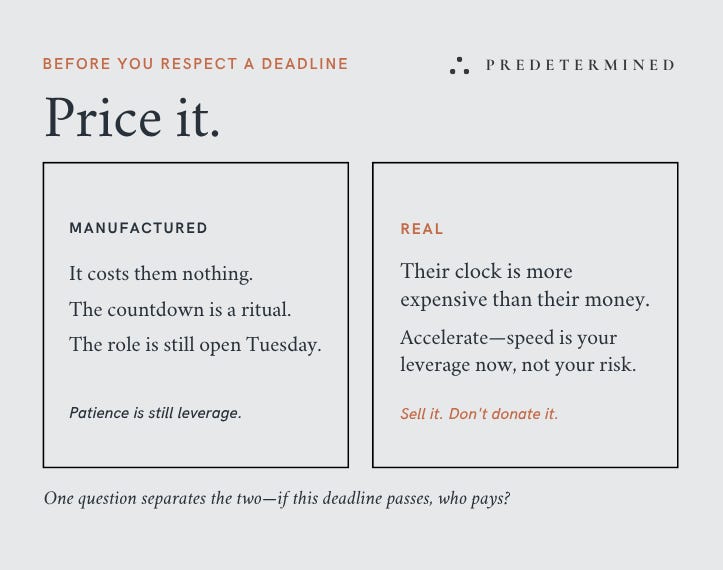
So before you respect a deadline, price it—what does letting this date pass actually cost them?
If it costs them something enormous, accelerate. Speed is your leverage now, not your risk.
If it costs them nothing, you’ve found theater.
I wrote an entire essay on the Friday-afternoon offer with the Monday deadline—the countdown is often a ritual, and the role is still open Tuesday.
One question separates the two.
The Lesson—If this deadline passes, who pays?
Urgency Inflates Value
A closing window bends the math. And it does it to everyone—my clients, their founders, me.
A deadline doesn’t change what an offer is worth. It changes what losing it feels like.
The moment something becomes scarce, it becomes more desirable—not because it got better, but because your mind prices the loss of it more dearly than the gain of it.
The window itself is doing the persuading.
That’s how we’re wired. It’s why the phrase “exploding offer” exists, and it’s why it works.
You can’t turn your wiring off. But you can catch it working.
When you feel the pull of a closing window, ask the question in reverse:
The Lesson—If this exact offer sat on my desk for a month, would I still want it?
If yes—move fast with a clear head.
If you’re not sure—the deadline isn’t revealing the offer’s value. It’s replacing it.
Speed Is a Concession
When they say we need an answer tonight, most people hear a threat.
It’s not. It’s an ask.
And asks have prices.
Most candidates say some version of “Wow—okay. Can I have until Friday? I need to run the numbers.”
That sentence buys time you may not need, and it tells the room your read isn’t done.
Here’s what works instead.
“I can move at your speed. Here’s what closing tonight looks like.”
Then your terms. Speed granted—and priced.
In this particular deal, closing within hours was worth real money—the compression itself became a line item. They weren’t only paying for my client’s expertise.
They were paying for a faster sprint.
They were paying so the competition couldn’t have it.
They were paying for what their shareholders would hear.
They were paying for the story they’d tell their own team.
And they were paying to skip the global search for the handful of people who might pull it off.
The Lesson—If your speed is worth that much to them, it should never be free.
Their Calm Is Not Their Command
Remember the encrypted threads?
Five lawyers—two on our side, three on theirs—trading redlines through the evening. A comp committee reacting to numbers it hadn’t approved. Founders overriding everyone in real time.
From the outside, none of that was visible. My client heard one polished voice delivering clean deadlines in clean sentences.
Executives often freeze in fast deals because they assume the other side is a machine and they alone are improvising. The asymmetry you’re afraid of mostly isn’t there. In a sprint, nobody’s version of the deal is final—not even theirs.
Which changes what you’re allowed to ask for.
In a slow deal, reopening a settled term is a battle.
In a fast one, half the terms were never really settled.
The two sides just haven’t reconciled yet.
Some of the best language in that deal got in because we asked for things one side’s lawyers thought the other had already closed.
So treat every “that’s already been decided” as what it usually is in a sprint—one person’s version.
The Lesson—Ask anyway.
The Read Beats the Hours
I used to believe long timelines found the ceiling. Stretch the process, gather intelligence, and let pressure build.
Time as the instrument.
Here’s what I believe now.
Time is an instrument—and it only works while it’s buying you something.
Intelligence you don’t have yet. Alternatives that need weeks to mature. Their deadline starting to hurt.
For most people, in most deals, that’s exactly why slowing down is still right. Your read isn’t done—you don’t yet know what your alternatives are worth, and your ceiling is still a guess.
Time is how you find out.
The read is the thing I’ve actually been selling my whole career, so let me define it plainly.
The read is muscle memory from thousands of deals—pattern recognition, intuition, and expertise, delivered at precisely the right moment. Who holds the budget. What losing you costs them. Where the flinch lives. What you’d trade before anyone asks.
The long timeline was never magic. It’s just what building a read usually costs—and it’s why so many executives are at a massive disadvantage. You do this for yourself a few times in your career—they do it daily. They have a mountain of structural precedent—you have limited documentation and chicken scratch notes on what a friend in an adjacent market did.
That’s the honest reason two hours was enough in this deal—nothing got figured out inside them.
The walk-away, the target, the trades we’d take under pressure. All of that existed before the phone rang, because we’d been living in the deal for months.
Months of time, doing its actual job. The window didn’t compress the thinking. It compressed the paperwork.
Now the part where I practice what I preach, badly.
This deal never went under contract.
We did it in three sessions, billed by the hour, and my standard structure would have paid a large multiple of what I invoiced. Seven figures large.
Four lessons ago I told you speed should never be free. I gave mine away at my day rate.
Afterward, my client and I sat with my contract—they were helping me rework it for exactly these situations—and the feedback was simple.
They’d happily sign a capped rate at a multiple of my hourly rate for access when they needed it. No percentage. No long engagement.
Just Jacob’s read, on demand.
That’s my market telling me what the product is.
My highest-output clients need less and less of my time—they need the right read, made fast, so they can get back to work.
So my practice is adapting in real time, the same way my playbook is. I’m still working out what a read costs when it arrives in minutes instead of months.
And for what it’s worth—I felt thoroughly beaten walking away from this one.
Not by my client. By the trade I keep making.
These rooms are the frontier of my own market, and I keep discounting my way into them because I want the experience and the circles more than I want the rate.
Maybe that’s tuition. Maybe it’s a green light I never actually set.
So I’m finally running my own play—deciding, before anything is urgent, what these rooms are worth to me and what they’re not.
The same move is available to you, and it costs nothing—decide your green light while the room is quiet.
The number that gets your yes. The two things you’d trade to reach it. The one thing that makes you walk. Decide them before your most demanding conversations begin. You know what happens to your math inside a closing window.
The Lesson—When the window opens, you don’t build the read. You load the one you already made.
The Clock Is a Price
One caveat. Most deadlines you’ll face this year are still manufactured.
None of this is a reason to panic.
Everything I’ve ever written about patience still applies to “standard operating procedure”—which is usually just theater with a calendar invite.
In the fastest market I’ve ever worked, the people at the top rarely bother with the last five percent. Their scarcest asset isn’t dollars. It’s hours.
I got into this work believing leverage was something you built slowly.
At most altitudes it still is.
But the clock was never your enemy or your friend.
It’s a price.
Read it like one.
Ready to discuss your career? Request an engagement.
Stay fearless, friends.
The story was a riveting read, it is highly unlikely we'll ever be in these rooms (on any side!) but ... you were actually telling a different story. The point on "That’s my market telling me what the product is" hit home.
At times I want to sell something but the market asks for only a part of it or something adjacent ...and I respond to the asks.
It is much harder to recognize when the market appears to be walking away but in fact is asking for a part or an adjacency to your offering. You caught it in this instance! And you taught it to us, thank you.