


The offer arrived at 4:52 PM on a Friday.
Warm subject line. Exclamation point. “We’re thrilled to extend...”
Then, three paragraphs down, almost apologetic: we’ll need your decision by Monday morning.
My client forwarded it to me with one line: “They seem really excited. I don’t want to blow this by pushing.”
That sentence is the product.
Not the offer. The sentence.
The company spent three months and eleven interviews engineering the moment where a senior executive—someone who negotiates eight-figure vendor contracts without blinking—looks at his own compensation and thinks I don’t want to blow this by pushing.
Companies don’t want to beat you at negotiation.
They want the negotiation to never happen.
The Discipline Nobody Tells You About
The recruiting industry has a name for this. They call it candidate control.
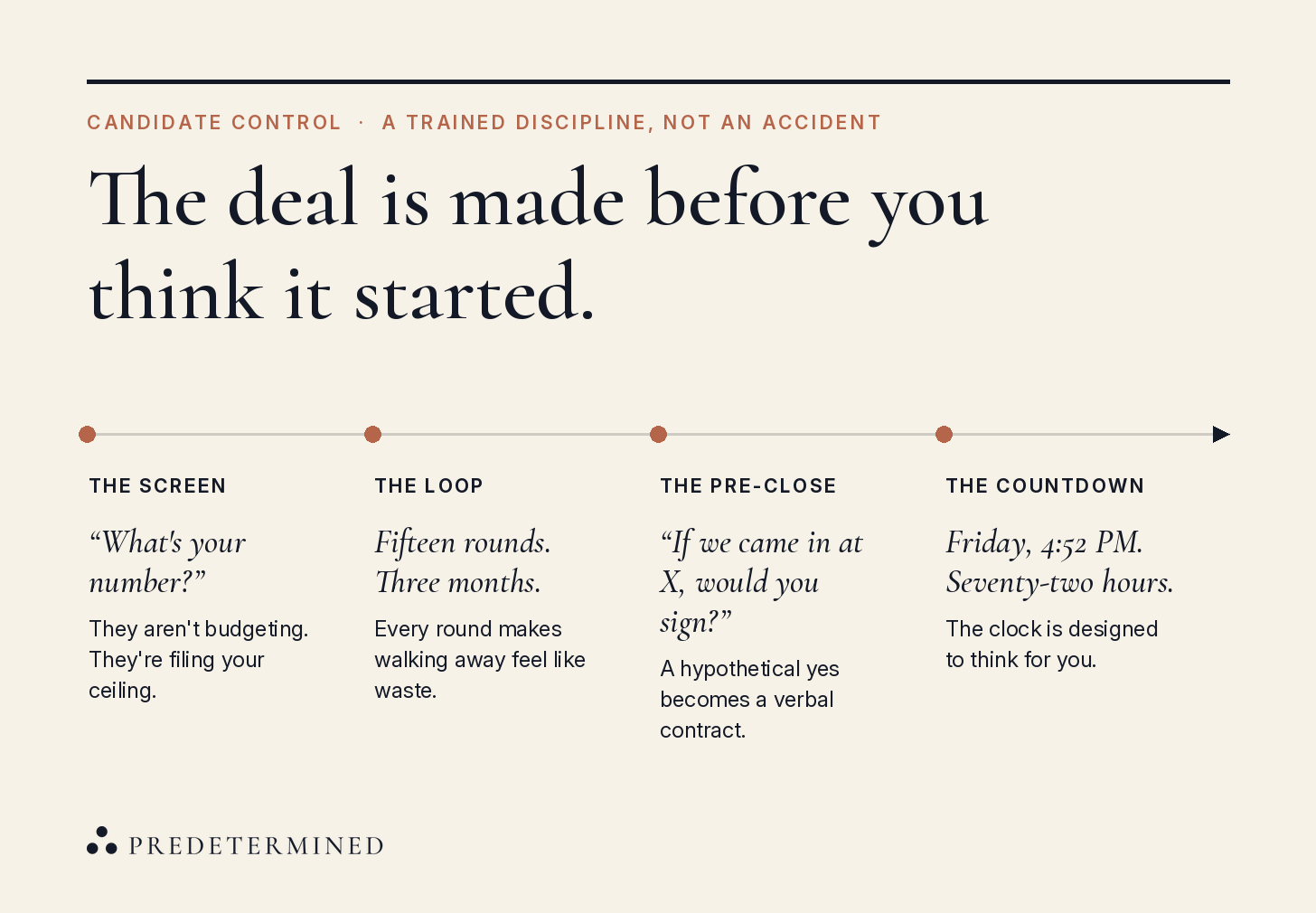
It’s not a conspiracy theory. It’s a training curriculum. Recruiters are taught the trial close, the close, and the re-close. They’re taught to test your motivations with hypotheticals weeks before an offer exists—if we came in around this range, is there anything that would stop you from signing?
They’re taught to inoculate you against counteroffers from your current employer before you’ve received one. One industry training puts the doctrine in a single sentence: the deal is made long before a candidate formally signs.
Read that again.
The deal is made long before you sign.
Which means the deal is made before you think the negotiation has started. Which means by the time you sit down to “negotiate,” you’re not negotiating.
You’re confirming.
None of the people running this playbook are villains. Most recruiters are decent, most hiring managers are sincere, and most of them believe the rituals are just how hiring works. That’s what makes a ritual a ritual—the people performing it don’t experience it as a choice.
But you should.
Because every one of these rituals has the same objective. Make the calibrated number feel like weather. Something that happens to you. Something nobody decided.
Somebody decided.
Here are the four rituals I see most, what each one is actually doing, and the move that breaks it.
Ritual One: The Weather Report
The line: “This is just what the role pays.”
Sometimes it arrives as “the band for this level is X.” Sometimes it’s “we have to maintain internal equity.” Always delivered in the tone of a meteorologist. Nobody’s fault. Nothing to be done.
Bring an umbrella.
What it’s doing: Converting a decision into a fact of nature. Bands are not weather. Bands are policies—written by people, revised by people, and exceeded by people, constantly.
Every company that tells you the band is fixed has approved an above-band offer in recent memory. I know because I’ve been on the other side of the paper when they did.
The Weather Report works because arguing with weather feels insane. You can push back on a person. You can’t push back on the sky. So the company removes the person from the sentence and lets the sky say no.
The break: Never argue with the band. Change the question.
“I understand the band—and I’m not asking you to break it for no reason. It sounds like this is a unique scenario. Help me understand the exception process. Who approves above-band offers here, and what do they typically need to see?”
Every band has an exception path. Your job isn’t to win a debate about the band’s existence. It’s to find out who owns the exceptions and what evidence moves them—then supply it.
This is another reason why having internal advocates that you’ve worked with prior plays such an important role in compensation dynamics—and why influence is the gateway to breakout compensation structure.
And one more question, because the band conversation hides a bigger one: the fastest way to change what the role pays is to change what the role is. If the number is capped, the scope is the negotiation.
“What would this role need to own for it to sit a level higher?”
Ritual Two: The Ally Without Authority
The line: “Share your number with me so I can fight for you.”
Later in the process, the same person returns with: “I pushed hard, but the comp committee’s hands are tied.”
What it’s doing: This isn’t about whether recruiters are good people. Most are. It’s about what the role is designed to do—and the role is designed so that “no” never has an author.
Notice the architecture.
The person you talk to can’t say yes. The people who can say yes never talk to you. Your number travels up stripped of your reasoning, and the ceiling travels down stripped of its owner. When the answer disappoints you, there’s no one in the room to be disappointed at.
The committee is always absent. The hands are always tied. The tying is the point.
Sounds eerily family to the sales manager at your local car dealership running a circled payment figure by finance only to shatter your counter numbers.
And the opening move—share your number so I can fight for you—is the oldest extraction in the book. Since salary-history questions started getting banned, “expectations” became the new anchor.
Your ally isn’t collecting ammunition to fight for you. They’re collecting your ceiling to file it.
The break: Warmth toward the person. Questions about the system.
“I appreciate you advocating for me—genuinely. Since you’ll be carrying this forward, I’d rather arm you with the case than a number. Here’s the specific problem I solve and what it’s worth to the business. And so I understand the process: who actually approves the final structure?”
You give the messenger a story to carry, not a ceiling to cap. And you map the room where the decision actually lives—because that’s the room your narrative has to reach, with or without you in it.
Ritual Three: The Gift Wrap
The line: “We put together something special for you.” Or its cousins: “Leadership personally approved this.” “We really stretched here.”
What it’s doing: Turning an offer into a gift. And you know what you don’t do with a gift.
You don’t negotiate it. You say thank you.
This is the most elegant ritual of the four because it weaponizes your best quality—your decency—against your own family’s balance sheet.
The moment the offer becomes personal, a counter becomes ingratitude.
They handed you something wrapped, and now asking about the contents feels like tearing the paper in front of the person who wrapped it.
Here’s what fifteen years inside these deals lets me tell you—the bespoke offer is almost never bespoke. The number came off the same calibration as everyone else’s.
What was tailored for you was the presentation. “We stretched” is not a fact about the budget.
It’s a preemptive strike against your counter—if they already stretched, there’s nothing left to ask for, is there?
There’s usually plenty left.
The break: Accept the relationship. Decline the frame.
“I’m genuinely grateful for the care that went into this—and it’s exactly why I want to get the structure right. This is a multi-year commitment for both of us. Let’s make sure the package maps to the mandate.”
Gratitude and negotiation are not opposites.
Separating them is the skill. The people are the people; the paper is the paper. You can love the first and mark up the second—and the executives who can’t hold both at once are the ones the Gift Wrap was built for.
Ritual Four: The Friday Countdown
The line: “We’ll need your decision by Monday.”
Delivered, with uncanny consistency, late Friday afternoon.
What it’s doing: The company took three months to decide on you. Fifteen interviews. Panels, take-homes, backchannel calls you never knew about. Then it hands you the largest financial decision of your decade and gives you a weekend.
That asymmetry is not sloppy scheduling.
The clock is designed to think for you.
A hard deadline reads to your body as a closing door, and a closing door narrows everything—suddenly you’re not evaluating a decade of equity structure, you’re staring at a countdown. The offer stops being an opportunity to assess and becomes a possession about to be taken away.
That’s when smart people sign bad paper. And remember, no deal is better than a bad deal. We need to do better than that.
Now the part that should make you angry, or laugh, or both.
Researchers at INSEAD ran the exploding offer through behavioral experiments and found it doesn’t even work. Candidates accepted pressured offers at roughly the same rate as patient ones—and the ones who accepted under the gun punished the employer afterward with less commitment and less effort. The researchers called it the reciprocation curse.
So the deadline doesn’t capture more candidates. It just captures them worse. And companies keep doing it anyway—because the ritual was never about the match.
It’s about making sure the calibrated number gets signed before you can test the market, compare paper, or think. Haste once again equals risk.
The break: Test the clock. Calmly.
“Thank you—I’m excited about this, and a decision of this scale deserves a real evaluation. I’ll have my answer by Thursday.”
No apology. No permission sought. A statement, delivered warmly, followed by silence.
Here’s what happens next, in almost every case: nothing.
The deadline was theater, and theater evaporates when one actor declines the scene. In fifteen years I have watched countless deadlines dissolve under a single calm sentence—because by the time a company extends an offer, walking away from you costs them a restarted search, an embarrassed hiring manager, and a story they have to tell the board.
Your extra four days cost them nothing—though it could make a backup candidate waiting in the wings sweat a bit longer—and challenge how they keep them engaged while they really focus on you.
If the offer detonates (which I have never seen FWIW) because a serious executive took until Thursday?
You just received the cheapest possible preview of how that company treats people under pressure. Some tuition is worth paying before you enroll.
The Part That’s Up to You
Look back at the four breaks.
A question about the exception process. A story handed to a messenger. A thank-you that keeps its wallet closed. A calm sentence and four days.
Not one of them is aggressive. Not one requires you to become the shark you’re afraid these conversations will turn you into. That’s the misunderstanding that keeps executives compliant—the belief that the alternative to accepting the ritual is combat.
It isn’t. You don’t beat a ritual by fighting it.
You beat it by declining to perform your part.
The company wrote a script in which the band is weather, the recruiter is your ally, the offer is a gift, and Monday is a law of physics. You were cast in that script without auditioning. Every ritual depends on you reading your lines.
Put the script down.
The number was calibrated before you walked in. Whether it stays that way is the only part of this that was never predetermined.
That part is you.
Work with me directly. Every session credits toward representation.
Stay fearless, friends.
Excellent reframes.
Excellent advice. An “experienced” company recruiter, HRBP or retained search firm contact - whomever is “leading” the search or hire and the day to day contact for the candidate, if s/he really knows what s/he’s doing and “how” to communicate with the hiring team (some do, some don’t - some function more like a telephone operator of yesteryear) can be a finalist/new hire’s greatest ally/advocate in these scenarios. In 25 years of retained exec search and corporate TA, I have had only one client, a major broadcast network, refuse to honor the finalist’s deadline extension request. That’s how this company operates, and I made no bones about it from day one - once it became apparent that the finalist was moving forward. Communication is key. It solves a lot of headaches for the company and candidates. In addition, working internally on the TA team of a large corp., I have had to go back-and-forth multiple times with the company’s head of compensation (at large companies, comp has its own “team” which along with HR, has to approve and sign off on the Offer which moves in steps, through the HR /recruiting software), trying to get a director-level hire from the top tech company in the world, the package she wanted and .. a senior director title, not director. while the hiring leaders (C and his VP) and I would never let her slip away and were her fiercest advocates, we literally have to convince HR and Comp to approve our decison. Bc that’s how it works at some companies - Comp and HR have to “stick to” their bands, pay grades, as you point out. There is always room for creativity when putting more money on the table (signs ons, more RSUs in Y1 ) - but never in terms of title. It makes recruiting very challenging when comp and title are wildly “out of whack” with the rest of the market, especially when recruiting senior-level specialized or tech talent. No VP at MS wants to drop down to a Sr Director title — no matter how much the Director role is paying. So lots of nuance with what us experienced recruiters are up against — but working with a highly competent recruiter on the inside (a company recruiter) or at the search firm level, is invaluable.