


I need to tell you something that sounds like it ends my career.
I’m the person you hire to find the ceiling—or shatter it. Fifteen years, thousands of engagements, over a billion dollars in lifted outcomes. If anyone on earth should believe the highest number wins, it’s me.
Right?
And the smartest executives I’ve ever represented—the ones who play this game across decades, who compound instead of climb—routinely don’t take the highest offer.
Not because they couldn’t get it. We got it. The ceiling was located, priced, and put on the table.
They looked at it. And they picked something else. They don’t have the illusion of choice. Rather, they exercise their choice regularly. An enviable position to many others.
The first few times I watched this happen, I thought I’d failed. The number was right there.
It took me years to understand what they were actually doing.
It’s likely because I’ve always had a tenuous relationship with working for somebody else’s company—and thus always pushed for the highest compensation possible.
But they weren’t doing offer math.
They were planning moves way ahead of what any market expert could predict.
They were doing decade math.
Offer Math vs. Decade Math
Offer math is the arithmetic everyone knows. Base, bonus, equity, sign-on. Stack the columns, compare the totals, circle the biggest one. It answers a single question: what am I worth today?
Decade math asks a different question: what does this deal build?
And the moment you ask that question, the columns change. The biggest package and the best deal stop being the same thing—sometimes they’re not even close.
Decade-thinkers read the term sheets everyone else skims
Equity quality, not equity quantity. Two offers, same equity value on paper. One is common stock behind three preference stacks at a company that hasn’t refreshed a grant in four years. The other is a cleaner instrument, a real refresh culture, and a credible path to liquidity.
The paper says they’re equal.
The decade says one of them is a lottery ticket and the other is a real stake. Offer math can’t see the difference. It’s not in the columns.
Board access. The room you sit in determines the next three offers you’ll ever receive. A slightly smaller package that puts you in front of the board eight times a year is worth more than a bigger one that buries you two layers down—because the people in that room run other companies, sit on other boards, and make other calls.
You’re not being paid in dollars alone. You’re being paid in proximity.
Proximity compounds. Dollars depreciate.
Future deal flow. Every seat is a node, not a destination. The decade-thinkers ask what this role generates: which relationships, which stories, which proof.
“I took a business from 40 to 200” is an asset that pays out for fifteen years. The seat that produces that sentence is worth more than the seat that pays 20% better and produces nothing you can carry out the door.
Scaffolding. The support around the role—the quality of the team, the clarity of the mandate, the sponsor who wanted you there.
A top-of-market package for a role you’re set up to fail in isn’t a win. It’s a down payment on a scar. The decade-thinkers walk the scaffolding before they price the seat, because comp for eighteen doomed months is the most expensive money you’ll ever earn.
Especially if you snatched an inflated title that the market doesn’t respect while you try to figure yourself out for the next several years.
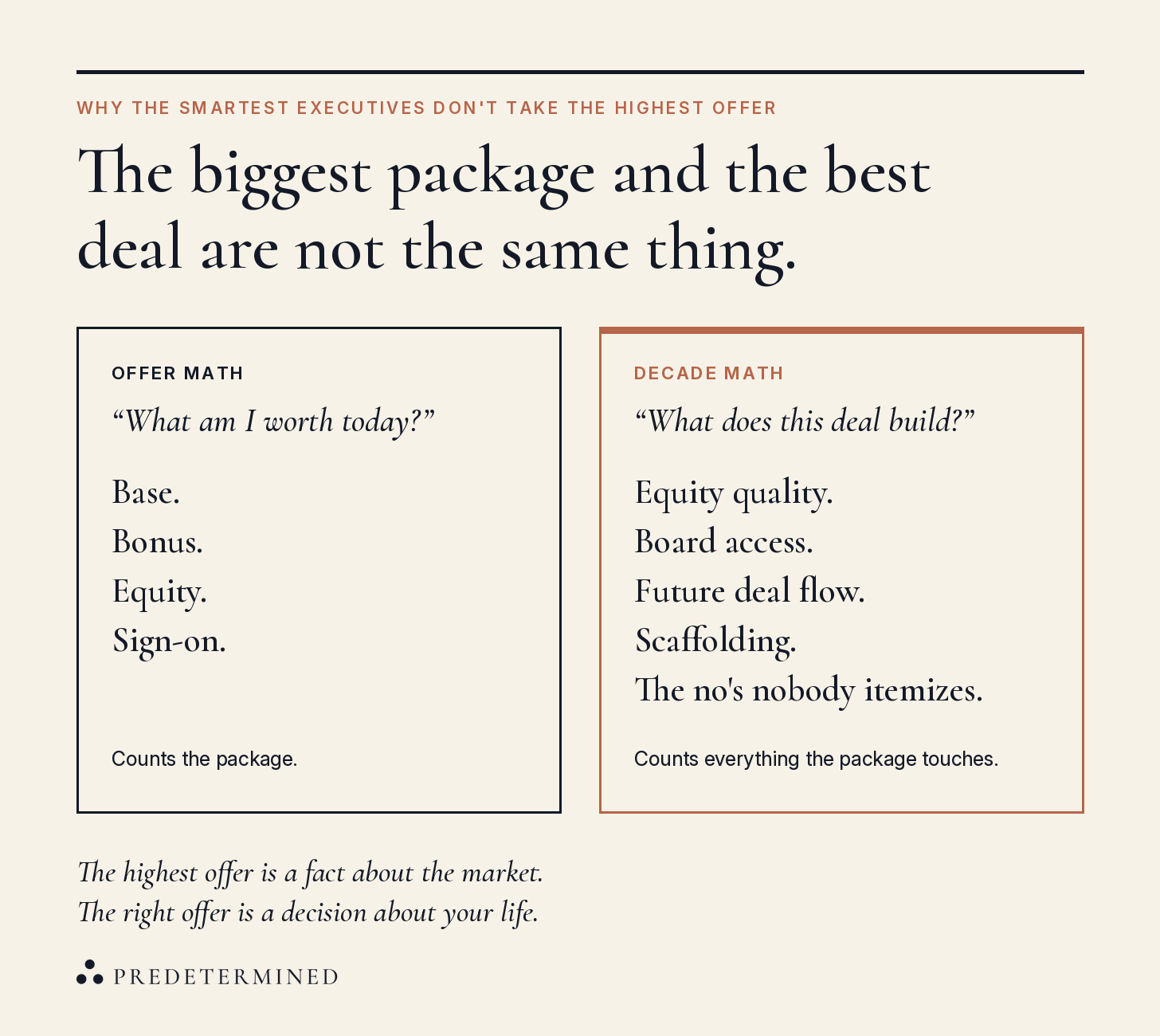
None of this shows up in the offer letter’s bold total. All of it shows up in the decade.
Why They Love the Deal Everyone Else Fears
They are not afraid of performance-based compensation. They prefer it.
Milestone triggers. Outcome tranches. Comp that only breaks the band when the business breaks its plan. The structures most candidates flinch at—what if I miss?—are the structures decade-thinkers ask for by name.
The reason is simple, and it’s a little confronting.
Performance comp is only frightening if you’re not sure you’re the person you’ve been claiming to be.
It’s a signal of confidence, competence, and certainty—for both you and the employer.
The decade-thinkers know.
They’d rather own their upside than rent their certainty. Guaranteed money prices them at the market’s confidence level; outcome money prices them at their own. And in every scenario where the bet pays, the company won bigger too—which means the check gets written with a smile instead of a grudge.
That’s not risk tolerance. That’s self-knowledge with a term sheet attached.
I’ve written the full playbook for structuring these deals—the sequencing, the scripts, the supplemental-agreement path. The mechanics matter. But the mechanics were never the barrier. The barrier is that betting on yourself requires knowing what you’re betting.
The decade-thinkers know. That’s the tier.
The Turn Nobody Sees Coming
Now the part I’ve never written before. The part that decade math produces which offer math cannot compute.
Sometimes the answer is less.
Not less because you couldn’t get more. Less because you looked at what more costs, and declined to pay it.
I need to say this carefully, because everything I publish teaches you to find the ceiling.
Find the ceiling. Always.
Curiosity over certainty, range over fog, clean asks over hedges.
But finding the ceiling and living at the ceiling are two different decisions—and the second one deserves as much rigor as the first.
Because the ceiling has a price tag that never appears in the offer letter.
The tall poppy is real. The highest-paid executive in the building is the first name the CFO’s sort function surfaces when the quarter goes sideways.
The premium you captured is remembered by everyone who approved it—and quietly resented by a few. Maximum comp buys maximum scrutiny, and scrutiny is a tax you pay in cortisol.
And that’s the cheap part.
The expensive part is the ledger nobody audits.
Every yes is a no you didn’t say out loud.
The 80-hour weeks are a yes—to the package, the mandate, the scoreboard.
The no’s they contain don’t get itemized:
Your best thinking, which doesn’t happen at hour eleven of a day.
Your healthiest remaining years, which are not evenly distributed across your life and are not for sale back to you later.
The attention your kids are still young enough to want.
The parents who are aging on a schedule that doesn’t care about your vesting cliff.
Money doesn’t solve a single item on that list.
Past a threshold—and executives at your altitude passed it a while ago—each additional dollar buys measurably less life. The returns diminish.
The costs don’t.
A year and a half ago I wrote a line in passing: you can always get more money, but you can’t get more time.
I no longer think I said it strongly enough.
What Would Your Life Look Like With Less?
Try asking the question. Actually asking it—not as a thought experiment you dismiss on the way to the counter.
What would your life look like with less?
It’s a deeply un-American question. Everything in the water we swim in says maximize: the bigger title, the bigger package, the bigger exit. More is the default setting, and defaults, as you know by now, are scripts somebody else wrote.
Up and to the right—so to speak.
That’s the part that took me the longest to see.
The reflex to maximize is itself predetermined. Nobody sat you down and asked whether the top of the range was where you wanted to live. The culture decided, the scoreboard decided, the LinkedIn feed decided—and you executed a decision you never made.
The decade-thinkers make it on purpose.
Some of them max the deal, clear-eyed about the costs, because the mission is worth it and the season is right. Some of them take the 70% package with the four-day reality, the board seat, the equity that might actually matter—and buy back Tuesday afternoons with their daughter while she still wants them.
Both are winning. Because both are choosing.
I know this one from the inside. I could have scaled my practice into a firm years ago—partners, associates, leverage, a number with more commas.
I chose a solo practice in a small Montana town instead, and built the structure so the work got bigger while my hours got smaller. I deleted a LinkedIn following most people in my field would trade a limb for, because the scoreboard it kept was measuring a game I’d stopped playing.
By offer math, I’ve left a fortune on the table.
By decade math, I’ve never done a better deal.
Negotiation Isn’t For Sharks
Now you know the real reason.
People assume that someone who does what I do must be an extraction machine—teeth, leverage, pound of flesh. The assumption isn’t just wrong about me.
It’s wrong about the game.
The shark thesis assumes the maximum is the point.
But I’ve sat close enough to the maximum, for long enough, to see what it costs the people who capture it without choosing it.
The biggest checks I’ve ever lifted are not the deals I’m proudest of. The deals I’m proudest of are the ones where the structure fit the decade—where the executive walked in aligned, stayed aligned, and five years later the deal still looked smart from every seat at the table, including the dinner table.
Alignment and fulfillment beat everything in the end.
Not as a greeting-card sentiment. As an observed, repeated, fifteen-year pattern in the outcomes of the most successful people I know.
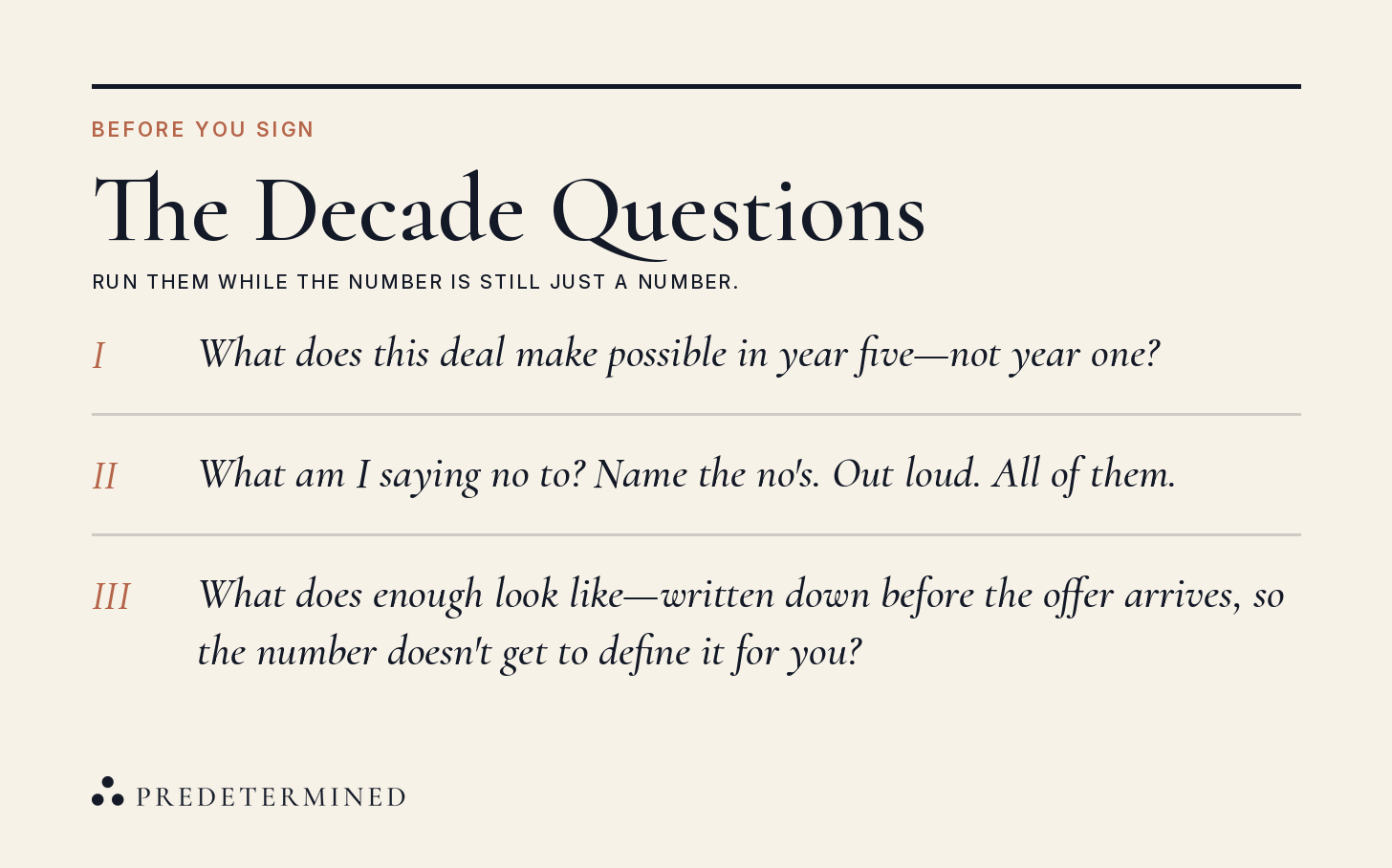
So before you sign the next one, run the decade questions:
What does this deal make possible in year five—not year one?
What am I saying no to? Name the no’s. Out loud. All of them.
And what does enough look like—written down before the offer arrives, so the number doesn’t get to define it for you?
Find the ceiling. That part never changes—you can’t choose what you never discovered, and walking away from money you could have had is only a choice if you could have had it.
But then make the second decision. The one nobody’s watching. The one the scoreboard can’t see.
The highest offer is a fact about the market.
The right offer is a decision about your life.
Enough, chosen on purpose, is the most predetermined-proof number there is.
Ready to discuss your career? Request an engagement.
Stay fearless, friends.
Did you find this revelation surprising? I would find it surprising if you found that surprising.
Another ear to frame this - maximize the outcomes. Find the ceiling but the ceiling need not be measured only in $s.. and also, at each point in time in one's life, the weight of $s could be very different.
So - maximize the outcomes, find your ceiling & find your own balance - works in decades and each decade most of us are a different person!