

Last month I sat in on a mock negotiation with a client. President-level role. Eight-figure package over four years if the equity performs.
For forty minutes he was flawless. Commanded the business case. Handled the hard questions. Sounded like the peer of everyone who’d be in the real room.
Then we got to the number, and he said this:
“I was thinking maybe somewhere in the mid-eights, if that works on your end.”
Read that slowly.
There are four separate retreats hiding inside that statement.
I was thinking—past tense.
He’s already distancing himself from the ask, like it belongs to an earlier version of him he’s prepared to disown.
Maybe—the number isn’t a position. It’s a suggestion.
Somewhere in the mid—not even a number. A fog bank where a number should be.
If that works on your end—permission requested. The other side now owns the verdict on his worth.
Forty minutes of executive presence, dismantled by one sentence.
In the real room, the person across the table hears all four retreats before you finish the sentence.
Because they’re trained to. It leaves them with a feeling that you’re not convinced of your own worth. So why should they be?
The Same Sentence, Every Altitude
Last week I showed you the company’s script—the four rituals they run to keep the negotiation from ever happening.
This week is harder. This week is your script.
Track a career from the floor to the top and listen for one sentence.
The analyst, three years in: “I was thinking maybe I could sit in on the client meeting?”
The director, year ten: “I was thinking maybe I could take on the platform team as well?”
The executive, year twenty, staring at the biggest package of her life: “I was thinking maybe somewhere in the mid-eights?”
The rooms changed. The stakes grew a thousandfold.
The sentence never changed.
That’s the part few recognize. We assume the habits of the floor get shed on the climb—that somewhere between manager and C-suite, the deferential language falls away with the cubicle.
It doesn’t.
The hedge rides along, invisible to the person carrying it, glowing like a flare to everyone else.
Two Hedges. Only One Has a Price Tag.
You know what a hedge is on Wall Street. A calculated instrument. You pay a known premium to cap your downside. Nobody buys a hedge without asking what it costs—the cost is the entire point of the conversation.
Now look at the other hedge. The one in your mouth.
Just. Maybe. I feel like. Sort of. I was thinking. Sorry to ask, but. This might be a dumb idea, but. If that works for you.
Same instrument, inverted.
The financial hedge caps your downside at a price you chose.
The linguistic hedge caps your upside at a price you never see.
And you deploy it a dozen times a day for free.
Except it isn’t free.
It’s the most expensive hedge you own—you just get the bill later, bundled invisibly into an offer that came in lower than it had to, a counter that stayed thinner than it should have, a “yes” that arrived suspiciously fast.
Why Your Mouth Buys Insurance You Didn’t Order
Now I’m supposed to tell you to stop using weak words, as if this were a vocabulary problem.
It’s not a vocabulary problem.
The hedge is a safety behavior.
It’s your body trying to shrink the ask so the rejection will have less surface area. If the request is small—just a quick question, maybe something in the mid-eights, only what I was thinking—then the no, when it comes, lands on something small.
The hedge is pre-paid pain relief for a wound you haven’t received yet.
For a lot of us, that reflex is old. Some of us learned early that playing small was how you stayed safe. The words aren’t a style choice. They’re armor from a life you left behind decades ago.
Which is exactly why “just be more confident” is useless advice.
You can’t out-vocabulary a threat response. But you can do something better: you can recognize that the threat is miscalibrated. The rejection you’re insuring against costs you nothing—a no is a data point.
The insurance costs you everything—because of who’s listening.
The Trained Listener
The person across the table has heard ten thousand asks. Comp conversations are your once-every-three-years event and their Tuesday.
That volume turns them into something you need to understand: a leverage-reading machine.
They are not parsing your sentence for meaning. They’re parsing it for softness. And the hedge answers every question they have before they ask it.
I was thinking maybe tells them the number is negotiable before the number arrives.
Somewhere in the mid-eights tells them the bottom of the fog is your real floor—so they can land beneath the middle of it.
If that works on your end tells them a thin counter will close you, because you’ve already assigned them the authority to rule on your worth.
None of this requires malice. That’s what makes it dangerous.
The system prices what you signal.
Hand them a hedged anchor and you’ll get the oldest move in the book—the split. They’ll meet you “in the middle” between their number and your soft one, and the middle of a hedge is always closer to their end than yours.
It feels like compromise. It’s a discount you wrote yourself. And again, you never find the ceiling.
And when a recruiter asks that famous question—“What would it take to get you to a yes?”—understand what’s being harvested.
They’re not exploring. They’re inviting you to hedge a ceiling into existence so they never have to reveal theirs.
Go Fish is a much easier game when your toddler can’t keep their cards from tipping toward your gaze.
Delete the On-Ramp
So what’s the practice?
Not aggression. Not bravado.
You don’t need harder words—the executives who overcorrect into chest-thumping lose just as much, differently.
You need fewer words.
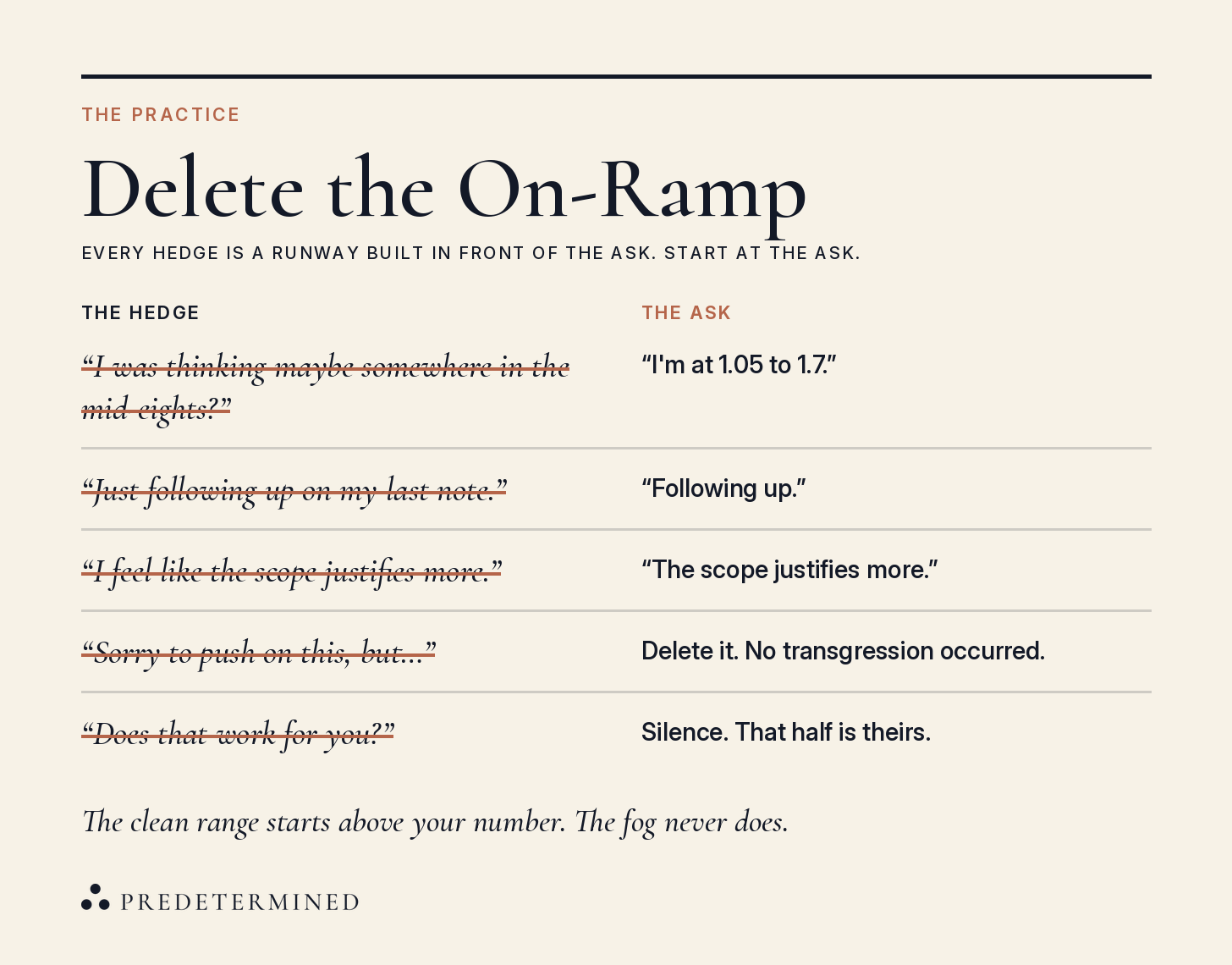
Every hedge is an on-ramp: a stretch of runway you build in front of the ask so you can approach it gradually. The fix is almost embarrassingly simple.
Delete the on-ramp. Start at the ask.
Script A—the hedge:
“I was thinking maybe somewhere in the mid-eights, if that works on your end?”—
Script B—the ask:
“I’m at 1.05 to 1.7.”
Then nothing.
The silence after your number is not a gap to fill. It’s the second half of the sentence—and it belongs to you.
Now look closely at Script B, because it breaks a rule you might have expected me to hand you.
It’s a range.
Isn’t a range the fog bank I just spent a thousand words demolishing? No—and the difference is worth millions.
“Somewhere in the mid-eights” is a range built around your hope. It’s hedged at both ends, it drifts downward, and the trained listener lands beneath the middle of it every time.
The clean range is built above your number. In my practice, the bottom of the range sits roughly 20% above the figure my client would happily sign. The top runs toward double it. My client wanted mid-eights. The range opened at 1.05.
The fog anchors down. The range anchors up.
The research backs this architecture twice over.
Galinsky’s work at Columbia found the first number on the table explains as much as 85% of where a deal finally lands.
And Ames and Mason—Columbia again—found that ranges anchored upward from your target outperform single numbers: the other side feels pulled to respond inside the range rather than beneath it, and reads you as more cooperative while you’re anchoring higher.
Let that sink in.
The bolder structure makes you look easier to work with.
And the deals still don’t get rescinded.
Run the same demolition across the rest of your vocabulary:
“Just following up on my last note” becomes “Following up.”
“I feel like the scope justifies more” becomes “The scope justifies more.”
“Sorry to push on this, but” becomes—nothing.
Delete it entirely.
You are not pushing. You are working together, and standard business requests don’t require an apology, because no transgression occurred.
“Does that work for you?” becomes silence.
If it doesn’t work for them, they’ll tell you. That’s their half of the negotiation. Stop doing it for them.
Notice what none of these revisions do: none of them add force.
“I’m at 1.05 to 1.7” is not aggressive. It’s not even firm, exactly. It’s just complete—an ask with nothing stapled to it.
The warmth you’re afraid of losing doesn’t live in the qualifiers. It lives in your tone, your pacing, the genuine curiosity you brought to the whole conversation before this moment.
If you need proof, researchers tested exactly this fear in 2019.
Firm first offers drew better counteroffers than warm, friendly ones—and here’s the part that should release you: the other side liked their counterpart no less.
The firm sentence wins, and nobody resents you for saying it.
Keep the warmth where it works—and please negotiate in person, on a walk-and-talk, or on a casual phone call or Zoom. Email is where pleasant tone and context go to die.
Precision and warmth were never opposites. Warm delivery of an exact sentence is the most disarming combination in any room I’ve ever worked.
And when they ask what would make you say yes? Don’t hand them a ceiling. Hand the question back:
“Let’s flip it—what does the business need this role to produce in the first eighteen months? If we get that right, the yes takes care of itself.”
The Distance Is Linguistic
The gap between the floor of your career and the top of it is not, at this point, a competence gap. You closed that years ago. Everyone at your altitude is competent.
The remaining distance is linguistic.
It’s the difference between seventeen words and five. Between an ask wrapped in insurance and an ask that stands there, unarmored, and survives.
The hedge protects you from a rejection that costs nothing.
And guarantees a discount that costs everything.
You already know your number. You’ve known it for weeks. The only question left is whether you’ll say it like a suggestion—or say it like a fact, start the range above it, and let the silence do its work.
Drop the maybe.
Keep the warmth.
Say the number.
Ready to discuss your career? Request an engagement.
Stay fearless, friends.
I do all of this subconsciously. In fact, I almost started this comment with “I feel like I might be doing this already…but not entirely sure since I can’t really hear it myself” out of habit. It’s really easy to resort to “retreat” language even in casual settings. When the pressure gets dialed up in a negotiation, we need to be all the more conscious of it. This perspective is helpful. Thanks, Jacob 😊